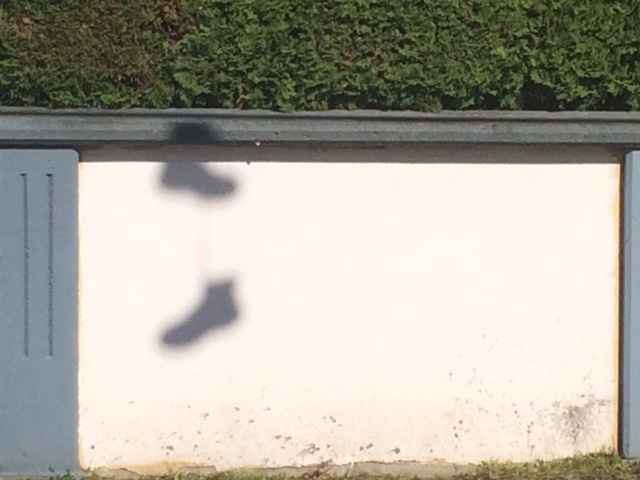
These haiku appeared at the height of the recent real estate boom in Vancouver; a boom that was driven by speculation, primarily by foreign buyers. Real estate became a commodity. Houses that had been around since the 1920’s were demolished and replaced by larger houses, some with an architectural style that had no context in the Pacific North West (white tiled French Colonial). Around where I live there was constant disruption: dump trucks, concrete trucks, agents knocking on my door, white Lexus’ (Lexi ?) driving up and down in front of the house every weekend, neighbours cashing in and leaving. Then like all bubbles, it burst or to be more exact, floated off to Toronto.
Ours was not a through street local traffic mostly and even that wasn’t a lot less than half the families owned cars. So around mid-afternoon when school got out an impromptu soccer game would start, the black tar strips that separated the concrete sections of the road would serve as goal lines the pitch could be expanded as needed, learning how to use the curb was key. In summer the Spanish students would arrive to learn to speak English with a Dublin accent, they were a lot better than us they spoke soccer fluently. Occasionally our neighbor, who was proud of her roses and didn’t like us trampling around to retrieve the ball, would call the police and we’d all scatter and re-group as soon as they were gone. Then just around 6 pm, doors would open all along the streets and aproned moms would call their kids in for tea, sausages, and baked beans on toast and slowly the game would evaporate leaving the street empty and my neighbor’s roses safe for the moment.
Suburban Desperation: About the American Dream (any consumer or capitalist fantasy will do), about the vast necropolis of suburbia and the things its revenants still carry out with deadly, ghostly, embalmed precision.
Obviously I haven’t done that. In Ireland there was too much history and ironic distance to talk about the American Dream. The American Dream was a construct that came to us through I Love Lucy. The suburbs I lived in spread south from Dublin and west into the Dublin hills, row upon row of semi-detached houses and yes they were all made out of ticky tacky and all looked just the same. At the center of these communities were cavernous churches to house the faithful on Sundays. But I can’t really impose, in retrospect, a negative narrative on this. When you’re a kid, it’s just the place you live, it’s what you know, it’s the place you get to be a kid in.
down by the canal bikes in a row on seedy side streets sex shops and sex shows stags and stagettes dildos in windows
but thank you for Heineken Rembrandt, Dennis Bergkamp Johann Cryuff Vincent Van Gogh
does art need anguish or does anguish need art
who knows, who knows? .
back in Vancouver an exhibition…
They’re taking photographs down by the water in front of the cubist whale float planes take off from the harbor the mountains slumber in the morning haze.
Inside the convention center paragraphs of opaque prose attempt to describe the genius of Vincent, Vincent van Gogh.
But if painting is the medium there is no need for go-betweens it’s all there on the canvas the painting is what the painting seems.
*
but now it’s Autumn
the leaves on the trees bordering the soccer field are leaking yellows and reds like a paint store catalogue
a scene to impress an impressionist
Where’s Vincent when we need him? Where’s Vincent when we need him?
This is a mash up of old poems and new in response to Brendan’s prompt on the subject of desperate beauty over at Desperate Poets.
The end of the world has come and gone but you remain standing on the eighteenth tee feeling the gravitational pull of the Planet Odd there’s no smoke without mirrors, you remark and looking down you notice that you’re still wearing a green polo shirt your favorite plaid shorts and your faded white golf shoes. Golf is the only sport that requires blandness of its heroes you think and then you think …where is this shit coming from and shouldn’t that be “demands blandness”? There’s a low hum, you look up, a large flying saucer hovers over the trees to the left of the fairway on top of the saucer is a giant inverted tea cup complete with handle a door opens in the side of the cup and you’re sucked up, through the door and into a room that looks remarkably like the original Star Trek control room. A guy who looks like Leonard Nimoy walks over and says:
“How’s it going? We’re from the Planet Odd or to be more formal, Earth 2. You see, the Creator royally fucked up his first attempt so we are the newer model, the second attempt. Still a few things to work out, but we’re not doing badly at all. We have created some illusions to make you feel at home, but first things first , amigo. Can I call you amigo?” You nod. “First things first, amigo, let’s get rid of those plaid shorts!”
This poem was inspired by a challenge from Brendan over at Desperate Poets :
“Here’s the challenge: Start with two oracles. You can follow my lead and use The Aenead as one source if you have a copy, but any classic text will do — the Bible, Shakespeare, a volume of your favorite poet or one on Native American myth, whatever. Open the book blind and let your finger fall where it may on the page and write down whatever lines you struck on. Or deal a Tarot card or iChing hexagram. If you don’t have any such tools at home, there’s a random Tarot card generator at https://randomtarotcard.com/. You can try an AI version of the Delphic oracle at < https://delphi.allenai.org/> and there’s an I Ching hexagram generator at https://www.eclecticenergies.com/iching/virtualcoins.
Next, cast a more self-referential oracle from something you created, a poem or journal or dream. Source a few lines in the same accidental manner.”
So I went to my book shelf , picked a book – “Daddy, Daddy” by Paul Durcan, opened a page and let my finger fall on the two lines that start the poem above. I then went to “Notes” on my IPhone which is where I record random lines, sayings, thoughts and found “the gravitaional pull of Planet Odd” and “there’s no smoke without mirrors” and I took it from there. Lots of fun, thanks Brendan!
(the Paul Durcan poem that provides the first two lines is called : The Martyrdom of Saint Sebastian.)
What a weekend that was truly a Marvel all the usual suspects were there and they were all into the sauce from the get go, Ricky the Rhyme King did his rap routine Simile Sal sang: Nothing Compares to U Assonance the Loud and Consonance the Cool hooked up again can’t keep those two apart and the bands The Meta Four and The Alliteration Alliance laid down a solid groove, and let’s not forget the families: the Sonnets – lovely people, very iambic the Villanelles – again lovely people but don’t get stuck in conversation with them they can be a tad repetitive the Lai’s , the Sestinas, the Rubai’s all knocking back the vino the Ghazals had visa problems and couldn’t make it but the Haiku’s and the Tanka’s came all the way from Japan (you don’t have to bow all the time, guys) and the Epics were there too it took five buses to fit them all in, but they made it. The highlight of the weekend of course was the Bad Pun Competition: For Better or for Verse and the winner for the tenth year in a row was, yes, Logan King of the Limericks. A great weekend indeed, all verse no chapter, some sore heads of course and some poetry in motion in the washrooms but well worth it.
“What subject, genre, sacred cow, or literary convention do you ache to spin until it’s dizzy? What mask do you long to pull off and drag a confession out of its wearer? What accepted wisdom do you long to expose as horsefeathers? Or perhaps you just want to set your keyboard on “stun” and knock us over with your unexpected use of language? Come on, flout convention! Irony and all major credit cards accepted. Unreliable narrators welcome.”
This is a post from a while back but with a new verse!
Thanks to The Galway Review for publishing two of my poems. They are more song lyrics than poems, so I’m not sure how well they work on paper (or the screen to be more exact). Other versions of the poems have appeared on this blog, but I think they may have finally settled down, although….
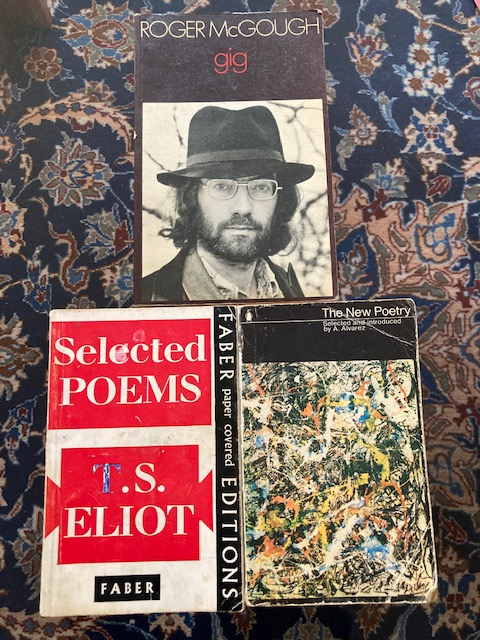
Just after graduating from university with a degree and no job I had time on my hands so I would take the 46A bus into the centre of Dublin and read poetry in Easons Books Store. Why poetry? Well, it’s hard to browse a whole novel. It was there I learnt ironic distance from TS Eliot and Roger Mc Gough, It was there that I learnt from Sylvia Plath that rhyming doesn’t have to be doggerel It was there I learnt from Robert Lowell writing about the woe that is in marriage that a poem could be a novel that a poem could cover the same subject matter as Updike, Bellow, Roth, Heller that poems don’t have to be about peat bogs and Celtic mist and that all good poems contain lines that snag on the brain like wool on a barbed wire fence and all for the price of the bus fare there and back.
This poem was inspired by a prompt over at Desperate Poets, where the incomparable Brendan asks us to “consider what influenced you as a poet and what you have done with those influences as you have grown and developed in your work. What bid you fly, where have you flown and what are you still looking for?”
If you haven’t done so already, check out Brendan’s blog, he puts out one prompt a week and they are always intriguing and inspirational.
The picture above shows that I did eventually buy some books!
Sitting in Mr. Courtney’s English class moving my feet to that iambic beat while greasy Joan doth keel the pot and snot runneth down the back of my nose.
He tells us he is not a happy man which makes us feel embarrassed, awkward, sad (behold the dawn in russet mantle clad) we pretend interest in (yes) Charles Lamb.
He struck me on the face once, hit me hard. Have at you varlet! A palpable hit! A snide remark I made, yes that was it, about poor Rosencrantz and Guildenstern.
Still, would this poem be, if not for him, Keats, beaded bubbles winking at the brim?
“There’s lots of reasons that people have for not doing things. Then the cats are gone, the children move away, the marriage breaks up or somebody dies, and you’re sort of there, like, “I don’t have anything.” A lot of things that had meaning are gone, and you have to start anew. But if you read Ovid’s “Metamorphoses,” Ovid writes about how, if you’re reading this, I’m immortal. You see that theme in Shakespeare’s sonnets: You’re reading this, so I’m still alive. In fact, they’re not alive, they’re gone, but while they were alive, they did have that extra dimension of their lives. That is not nothing.”
When I read this I thought of the above poem “Mr.Courtney” about my high school teacher. The poem has had a number of forms but ended as a sonnet. As Joyce Carol Oates also points out (see Brendan’s intriguing post) that memories fade but if you capture that memory in a poem, a novel, a painting it gets a life ot its own.
Mr. Courtney taught us Latin and English Literature. The curriculum was tilted towards the great English authors, like Shakespeare, Shelley, Keats. he was a big Keats fan. We had to learn whole poems and passages off by heart. Some lines are permanently stuck in my head and I have inserted them in to the poem here and there. And yes, he did clatter me across the face once, he could never quite look me in the eyes after that.
The sonnet idea came from Bjorn’s verse form challenge over at dVerse to write a sonnet. I’ve chosen an ABBA, CDDC, EFFE, GG rhyme scheme. I’ve used half rhymes here and there to add interest and tried to keep to a ten syllable line even though I haven’t always stuck to that iambic beat.
I have this memory.
I am walking across a field
a squelching field
a field that would suck your wellingtons off
the wind is a wet dish cloth
slapping my face
cow pats are dotted like landmines.
I love the countryside
but I don’t love this countryside
with its barbed wire fences
its ragged ditches
its baleful cows.
In the far corner of the field
I come across the rusty shell
of an old Mercedes
abandoned by the farmer
after one last muddy trip to the market,
and I’ve been thinking lately
I should take some ideas I have
some long held, unexamined beliefs
and park them in the far corner of a field,
top of the list being
the irrational notion
that somehow
against all odds,
we would all continue
to live, forever.
The ever eloquent Brendan over at Desperate Poets aks us to write an elegy. This is one from the past , I think it has perhaps an elegaic tone
It previously appeared on dverse (the prompt was “metaphors”)
tender is the night long is the day’s journey into night it’s easier to name a street car than it is to name one’s desire never attempt a ménage in a glass menagerie there is nothing less erotic than a red wheelbarrow a thing of beauty is a joy for a fortnight.
asks us to write about desperate desire. This is a poem from a while back about desire, thought it might fit, and here’s one about a different kind of desire.
The Reverend George Weeble
The Reverend George Weeble liked to visit churches in foreign lands, his parishioners called him: the steeplechaser. When I’m old and feeble, George Weeble said, when I retire, my one desire is to be where the spires conspire to show me the way.
I have a conservative friend who, lately, has started to use Woke the Word a lot. Every time he uses it, he wags his fingers above his head to indicate inverted commas. Sometimes he’ll give me a conspiratorial wink. The wink confuses me. What are we conspiring about? And the air quotes, who is he quoting? Or do they mean “so-called”, as in my boss asked me to take my laptop with me on my “vacation”. I asked him what he meant by “woke” and he was flummoxed. He mumbled something about pronouns, cancel culture, activists, political correctness. I explained to him that it was African-American slang for being alert to signs of racism, it came out of the Black Lives Matter movement and that being anti-woke technically means that one thinks one should not be alert to signs of racist behavior. This did not help. He had the notion that the woke crowd had it in for him in some way. When asked who the woke crowd are, again confusion….the left, activists, progressives…who knows. So I ask is all activism bad, is progress bad, no that’s not what he means. I think what he means is that the world is changing in a way that threatens him, the old assumptions do not stand. The arbitrary superior status he assumes because he’s an educated, upper middle class white male is no longer automatically acknowledged, taken as read. And it’s that woke crowd who are doing it to him. As history tells us …when a word or phrase is coopted by conservative white males, well that word is no longer groovy, far out, outta sight, cool ,hip; particularly when they think they are the first to discover it. Air quotes… for fuck sake…. Yes it is time to put Woke The Word to bed.
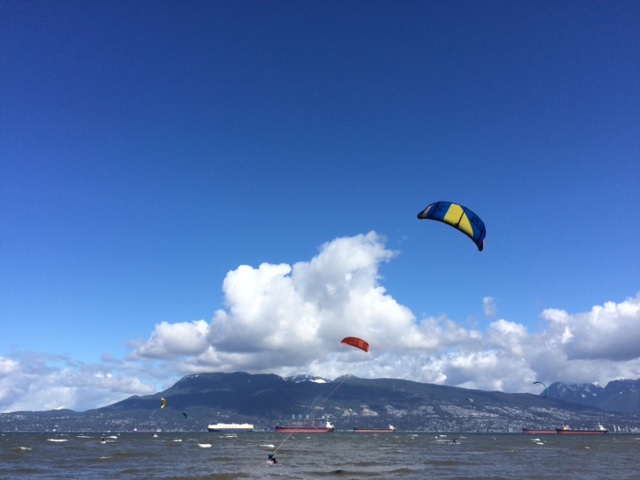
out on the bay kite surfers, tankers no smoke haze yet heat dome early days
two Canada geese pose for an Instagram shot necks extended rod taut
at their feet a gosling
proud parents they bob their heads like ageing rock stars
Brendan and Sherry , the creators of the now defunct earthweal have a new website. It’s called Desparate Poets
Check them out!
This Sherry’s challenge:
What makes you feel desperate where you live? What is changing? What is being lost? How is “Progress” making inroads on your landscape, and how do you feel about it? Give us a snapshot. It can be as broad as a seascape, a desert, a teeming city. Or it can be the opposite: finding comfort in the beauty around us, whether it is as vast as the sky or as small as a dew-covered spider-web, on a cornstalk by the back fence in the early morning.
A low metronomic plash waves flat-lining on the shore sailboats tacking kayakers kayaking, someone talking loudly about the cost of child care, two blankets down. It’s Father’s day and all the dads and kids are out throwing ball, kicking ball building elaborate castles in the sand and they are not alone, the ghosts of fathers passed are here too, including my own; pale-bodied, they roam the beach wearing old-fashioned swim trunks, grinning widely at the continuum of dads, kids, sun, sand and sea.
Landline (for Dad)
Sometimes, I think I should text my dad give him an update tell him where I’m at. Not that he would answer he’s been gone a few years now and even if he were alive texting would hardly be his thing; at the turn of the century he was still approaching what we now call a ‘landline’ with some trepidation.
Landline: a rope uncoiling towards the shore.
He once told me that when we have children we begin to understand our own parents better so I think my text would be an attempt to let him know that, yes, dad, I am finding this to be true.
In the town of High Dudgeon
at the corner of Grump Street and Curmudgeon
people talk about the old ways
about young people these days with their smart phones, their social media their Facebook, their Wikipedia hell, in our day we had to know stuff. Harrumph! They shout in unison. Harrumph! They shout harrumphantly.
Outside the town limits
the future raises a middle finger
and data accumulates
about this moment
and the moment before
in cabinets that hum
a one note tune.