The earnest English anthropologist
is talking about evolution.
He shows a film of long-haired men
digging on the shores of a lava lake in Africa.
Later, one of them appears wearing a big collar,
a big tie and bushy sideburns.
He has a collection of bones
which he assembles into a skeleton.
A debate follows
about the significance of tools
in our leap from ape to man.
On the coffee table is a copy of “The Little Red Hen”
as retold by Maria M. Southgate M.A. B.Com.
I make an astonishing discovery.
On page thirty-six, the little red hen
is cutting her field of wheat
with a very sharp knife,
and immediately I think: those idiots, those bell-bottomed fools as the clamber over each other into our bollock-naked past they have completely over-looked the tool-wielding fowl. All the degrees in the world, and they miss something so barn-door obvious
I found the above poem today in a box in my basement, while doing a pandemic purge. It was probably written in the late eighties. The odd thing is I was trying to figure out how to respond to Brendan’s prompt over at earthweal, in which he asks us to write about ”evolution” and this poem turns up out of nowhere. (There was a rejection note from Eiléan Ní Chuilleanáin of Cyphers magazine, saying she liked it but it was too much of “a one idea poem”.)
In the same box, I found another evolution related poem, which again I had completely forgotten about. I had to ask myself, have I actually evolved as a writer since then……and, you know, I’m not sure…..there is still that tendency to be facetious….talking of facetious, here’s the other poem..
Gorilla
There was a young lady from Orilla
who fell in love with a gorilla
in Toronto, at the zoo.
She could not stay with him
or have her way with him,
she did not know what to do.
Then the government
gave her a grant
to build a halfway home,
a micro-climate
for the primate,
a keeper out on loan.
With visiting rights
and hot jungle nights
all her problems were solved.
Until one day
I’m sorry to say
the goddamn gorilla evolved.
While lunching on rice and beans
I became aware of
the orange on my table
its thingness
its facticity
its outer skin
both verb and noun
but not noun
until it is verbed.
so I verbed it
and discarded the noun
without tasting it
on the grounds
that I don’t find
its taste appealing
or, to paraphrase,
its taste
does not
appeal to me.
Bjorn’s prompt over at dverse is all about verbing nouns
Is Joe
the rainbow
after the storm
the light
at the end of
the tunnel
the bar man
who will create
a cocktail
that is better
than the current mix
of braggadocio and bile,
garnished with a licorice stick
of lies, the Orange Russian?
Is he the man
to drive the sedan of democracy
straight down the middle of the road
to remind us of what
we used to regard as order?
Or does he have to be that?
It would be enough to be
the ornament on the hood
of that sedan,
because the thing is
he doesn’t have to be the thing
others can take care of the thing
he just needs to be
a symbol of the thing.
Is Joe
the rainbow
after the storm
the light
at the end of
the tunnel?
Jesus, I hope so.
The challenge from Brendan over at earthweal is “Write about storms and rainbows from whatever vantage seems most appropriate to you.”
Well, a lot has been happening in the Lads’ Poetry Project since we last checked in, we have two new additions to the project, both from the UK, and both of a quality that the project doesn’t deserve.
First we have Sarah Connor who gives us the view from the other room where there is a party of a different kind going on, find out more here!
Next we we have Kim Whysall-Hammond who gives us the perspective of the only woman in the room (she uses the word “engineer” in a poem which is a fairly rare occurrence), find out more here!
Sarah and Kim are both fine poets, so be sure to check out their other work when you are over there…and remember the Lad’ Poetry Project criteria are simple:
the poem must start with the phrase (or some variation of it): “Me and the lads…” and the tone must be somewhat less than elevated.
I wrote a nature poem once
it went like this: You call yourself a tree? My bank has more branches!
Not much of a poem really
I wrote it at a time when the Irish poetry scene
was dominated by rural poets
or to be more precise, by Seamus Heaney,
whose childhood memories
of peat bogs, tractors, ploughed fields, hard won harvests
of curlews and corncrakes of snipe and gannets
did not resonate with me
my childhood having been spent
in the newly spawned suburbs of south Dublin
where my friend Dermo and I roamed back lanes,
and vacant lots that promised prosecution to trespassers
a world of nettles, thistles, dock leaves for the stings
crows and magpies, a rumour of foxes
gardens of roses, dahlias, rhubarb, gooseberries
the ubiquitous potato
tadpoles in jam jars,
their embryonic frog legs kicking
and let’s not forget that dead cat we found
half consumed by maggots
in a cardboard box in the woods
behind the cavernous church
where Dermo liked to sit of a Sunday
close to the aisle, listening to the sound
of the women’s girdles as they strode up
for Holy Communion, according to Dermo
this is the sound that the girdles made: whick whick whick whick
but I digress…
I met Seamus Heaney once
north of the Liffey
a creative writing class,
this was before academia
and Nobel prizes
he was living in a cottage in Wicklow
he came, read some poems
and joined us in the pub afterwards
where I asked his opinion
of some of my heroes:
ee cummings, “a bit of a lightweight”;
Roger Mc Gough, the Liverpool Scene,
“a bunch of tricksters”;
James Simmons (a firebrand contemporary)
“does not understand the finality of print”.
These judgements were delivered
with a smile in a soft Derry accent,
a nicer man you could not meet
and one of two Nobel prize winners
that I have shared a drink with…
buy hey,
that’s more than enough name dropping for one poem.
Taking part in Sarah Connor’s challenge over at Earthweal.
Here’s Sarah’s prompt”
“So, for this prompt, I’d like you to think about how you first felt connected to nature – maybe as a child, or as an adult. Some of those lost words may inspire you, or you may have your own lost word (or world?) that gave you a sense of wonder at the natural world around you. Maybe you collected caterpillars, or watched birds on a bird-table, or squatted down to watch beetles, or looked up to see squirrels in the treetops.”
There’s a dog wearing a tartan skirt
outside the window of Starbuck’s;
a tartan skirt, a belt, and a knitted white sweater. Its little dog legs are moving frantically
on the wet pavement,
while across the slick road
and the sodden green park
the ocean sits
like a slab of lead
having clearly decided
to take some time off,
no crashing on the shore today.
South of the border
America blunders around
trying to remember
where it parked
that big ass car that everyone admired
and envied.
The people look to God
but God, once again,
is moving in mysterious ways
and I, for one, wish He would knock it off,
could He not for once in His eternal life,
clarify something?
I mean, for fuck sake,
there’s a dog wearing a tartan skirt
outside the window of Starbuck’s.
As we round Lee’s Circle in New Orleans
talk turns to statues
and the topless monument;
the shuttle bus driver tells us
that Robert E. Lee’s statue was removed
under the cover of darkness
by a crew dressed like ninjas,
to avoid recognition.
People woke up the next day
to find the statue had disappeared.
A photograph on Wikipedia
shows the statue being removed
in broad daylight by a crane;
reality is nearly always more prosaic.
She also tells us that she grew up in the neighbourhood;
as kids, they just called the monument,
“The Statue”, they did not know or care
who Robert E. Lee was.
In 1966, the IRA blew the statue of Horatio Nelson
off its pedestal on top of Nelson’s Pillar
in the middle of O’Connell Street, Dublin.
To my parents’ generation
Nelson’s Pillar was known simply as “The Pillar”.
(Dubliners are very fond of the definite article:
“How’s the head?”
“Are you still playing the soccer?”)
To them, The Pillar was a landmark
a place to meet your date
en route to one of the cinemas
on O’Connell Street to catch a film (2 syllables)
and perhaps a humid snog
in the back seat when the lights went out.
To the IRA it was a symbol of British Imperialism
of British oppression,
an insult to our patriot dead;
blah, blah, blah, boom!
The IRA was a particularly unsubtle organisation.
Is all this just facile juxtaposition,
chopped up prose
masquerading as a poem,
or is there a point?
Yes, yes and yes:
see what I think is
there are people who look up at statues
there are people who believe
statues are looking down on them
and there are people
who look straight ahead
and keep moving forward
into the future,
leaving the past
to its state of disrepair.
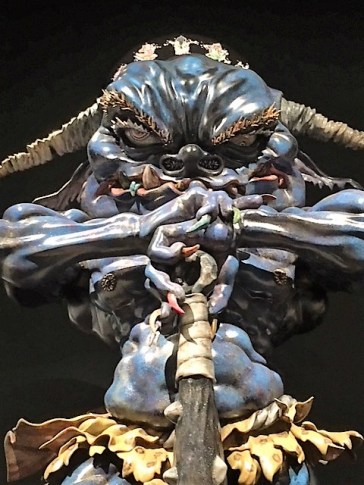
Top photo taken at the Takashi Murakami exhibition (The octopus eats its own leg) at the Vancouver Art Gallery.
Bottom Photo taken in Medellin, Colombia, statues by Fernando Botero.
The stars are out
luminescence rises
from the surface of the pond
I think of Tommy
Tommy Tumescent and the Hard-Ons
yes you could say
they were big in the fifties
yes you could say
they rose to stardom in the fifties
all pompadour and pointy toe
and to counter this puerile nonsense
I also think of iridescence
finesse
obsolescence.
This is one from the past, Taking part in Open Link Weekend over at earthweal
The Vancouver Folk Festival was cancelled this year for obvious reasons, we will miss it greatly…this is a post from 2018.
Highlights of the festival for me that year were Ry Cooder (and the Hamiltones), Wallis Byrd, Darlingside, James Mc Murtry and Neko Case. The performances were less politically overt than previous years, there was a sense that enough had been said and the diversity and inclusiveness of the occasion and the creativity on display was sufficient response to the ugliness, racism and bigotry on the march in some parts of the world.
………….
That was the year my friend, Slim, got a free weekend pass to the Festival by volunteering at The Wisdom Tent. All he had to do was turn up once a day and dispense wisdom for an hour. Slim is not a man known for empathy, so his choice of volunteer job surprised me. He could, for example, have volunteered at the recycle stations explaining to people the complex and arcane choices available to them; or perhaps, he could have dressed up in a tutu and sold raffle tickets, all perfectly good options. But no, he had to sit in a hot tent, imposing his gnomic bromides on the defenceless public.
Live from the Wisdom Tent
(I sat in on one of Slim’s sessions and secretly recorded it. The following is an edited transcript of the recording. Note: Slim sat behind a trestle table, his visitors approached one by one. I did not transcribe the sometimes withering and profane responses to his proffered wisdom.)
Slim:
walk past the writing on the wall look neither left nor right
************* always whistle past a graveyard
*************
today is the first day of the rest of your life tomorrow is the next
*************
walk towards the noise walk towards the noise
*************
neither a floater nor a settler be
*************
to find the person of your dreams you must first fall asleep
**************
if you’re feeling abysmal pepto bismol will do nothing
**************
talk softly don’t carry sticks of any size
**************
be all you can be then try harder
***************
like a frog down a well we only know the walls.
***************
to leave no footprint we must fly and never land.
***************
never drink anything blue
***************
life is waiting for the other shoe the secret is……..hang on, is that James McMurtry starting on stage 5?
(male voice) hey man, where are you going, you’re supposed to be here until 4? (Slim)…you should get rid of those dreads, you’re not from Jamaica. (male voice)…who was that pot-bellied old fart?
baselines, fault lines , paradigm shifts
ignorance has been weaponized
what will we do, what will we do
when all the nouns are verbed?
I think I made a mistake
how is there still doubt in that sentence?
A man goes to a party
to get infected with a virus
in order to prove
that the virus is a hoax,
the man dies.
It’s hard not to be harsh.
Is this a new baseline,
a new low?
Is it an intelligence deficit?
Is it lack of education?
No, this is something different
this is a sea change
the beast has left Bethlehem
the malware has been activated
the human race has started to self-limit.
Whatever god, assembly of gods
or conglomerate of alien scientists
malevolent or benevolent
that designed this whole shebang
that opened this can of worms
has had enough
the malware has been activated
the fix is in
it’s past midnight and the eagle has flown
Aunt Mary is hanging out the washing
the human race has started to self-limit.
A man goes to a party
to get infected with a virus
in order to prove
that the virus is a hoax,
the man dies.
Brendan over at earthweal poses the challenge: Observe shifting baselines in your world, in climate change, your nation’s governance, the pandemic.
slumped on the tide line,
mottled pink, exposed,
something has been picking at it;
six city workers
in high vis vests
with a garbage bin, a shovel
and a shroud of clear plastic
discuss the path forward.
The challenge from Brian over at dverse is to write a poem …… “capturing a moment in your verse”
Me and the lads are in the Beagle
carbo-loading after the game
we’ve got pitchers of pale ale
plates of chicken wings
nachos topped with something
that looks suspiciously like cat food. It’s pulled pork, I’m told,
which seems somehow apt
as I look around the table.
It’s the usual conversation
goals scored, goals missed
an unresolved conflict lingering
like a fart in an elevator.
Two of the lads are saying nothing
engrossed in stroking and poking
small rectangular tablets
as if expecting a message
that will change their lives
a revision to the ten commandments, perhaps,
one that sanctions the pulling of pork.
Whatever it is,
they can’t leave those little slabs alone.
Opposite me, Rob, an uncompromising centre half
with little skill and a liking for the long ball
is tucking head down into a plate of poutine,
fries covered in cheese curd and gravy,
suddenly with uncharacteristic speed and accuracy
he fires a gravy covered fry at the phone boys “put down your fucking phones”, he says quietly,
and out of nowhere I’m consumed by a wave of emotion
and I realise this is my community
and this is why I come here,
the level of discourse,
this is why I come here.
This week, I’d like you to think about that balance between the individual and the community. Where do you stand on the spectrum between lone wolf and team-player? How does your community support you? What are the communities you’ve chosen? What are the communities that have been thrust upon you? Can we be human without other humans? What are the threads that stitch us into place? They may be good or bad, or somewhere in between, but they are certainly there.
This is poem number 3 in a series of poems called The Lad’s Poetry Project. The goal of the series is to give space to a subject that is not normally encountered in poetry, Lad Culture. The only guidelines are: 1) The poem must begin with the phrase, “Me and the lads” 2) The tone must be somewhat less than elevated.
Today I thought about Reince Priebus
not so much the man,
more the strange music of his name;
those slender vowels reversing
that echo of wince
the possible meanings
a salve, an ointment put some Reince on that cut, son;
the Latinate portliness of Priebus
a writ to slap someone with – Habeas Priebus
a complicated skateboard manoeuvre he executed a perfect reverse Priebus;
then I thought of Anthony, dear Anthony, Scaramucci, Scaramucci will you do the fandango,
you were not long with us
but still the smell of aftershave lingers
and it was you who let us know
about Steve Bannon’s auto fellatio,
alas, poor Steve
abandoned on the side of the road
like a rumpled sofa
a rumpled sofa smelling of yesterday’s sweat
and stale doctrine;
and what about Spicer and Huckabee
cartoon characters
Plucky and Angry
your souls will be in the repair shop
for some time to come.
They appear in waves,
the arrested –
Flynn, Cohen and Stone,
the ones who once were serious people –
McMaster, Kelly, Bolton.
In years to come when men and women gather
to talk of greatness
your names will be long forgotten.
The list of the fallen goes on and on
and still Humpty sits on his wall
and still we wait for Humpty’s Great Fall.
This is the song I went looking for, the day Gord Downie died. I couldn’t remember the title, all I had was the phrase “over-opiated” which had been stuck in my head for years. Why? I don’t really know but maybe it was the triple iamb and the repeated ‘o’? Unlike a lot of The Tragically Hip’s music, this song was never in heavy rotation on Canadian radio, but I knew the song that contained the phrase was on the album ‘Up to Here’ and I knew I had a cassette tape of that album which I had bought back in 1990.
That was the era of the cassette tape and over the years, as tapes became extinct and compact discs, then streaming, took over, I stop listening to the album. So on the day Gord Downie died I found myself looking everywhere for it, eventually finding it in the storage space between the front seats of my red 98 Ford Taurus station wagon. There was some serendipity to this, because the only tape deck I have left is in the Taurus station wagon. A cassette and a Taurus sound system – not exactly high fidelity, but then the Hip were never really about high fidelity; put the vocal and drums on top of the mix and let the rest take care of itself. Besides, the sound system isn’t bad. There are 4 speakers , 2 front, 2 back, and if you switch everything to the 2 rear speakers and the bed of the station wagon is empty, the sound is actually pretty good, good enough for a bar band with 2 guitar players that sound like Keith Richards and Ron Wood but not as sloppy. I don’t normally drive the Taurus except occasionally to take stuff to the dump, but on the day Gord Downie died, I drove it around Vancouver all day listening to “Up to Here”. Yes, I was one of those guys you see in a parked car with the windows closed, beating time on the steering wheel.
And it struck me what a good rock lyricist Gord Downie is. Much has been made of his talent as a poet, and he is a talented poet, but writing lyrics for rock music is a different skill. For me, both rock and blues are all about the set up and the punchline. Take this for example:
“You ain’t nothin’ but a hound dog Cryin’ all the time You ain’t nothin’ but a hound dog Cryin’ all the time Well, you ain’t never caught a rabbit and you ain’t no friend of mine”
….Leiber and Stoller
Simple maybe, but deceptively hard to do well. Here’s Gord Downie from Boots or Hearts:
“Fingers and toes, fingers and toes Forty things we share Forty one if you include The fact that we don’t care”
Or this from the same song:
“I feel I’ve stepped out of the wilderness All squint-eyed and confused But even babies raised by wolves They know exactly when they’ve been used”
In fact, I could quote the whole song, because for me it’s as close as anyone has come to a perfect lyric. Or how about this from “New Orleans Is Sinking””
“Ain’t got no picture postcards, ain’t got no souvenirs my baby, she don’t know me when I’m thinking ’bout those years”
But Downie is also at heart a folk singer, a teller of tales. “38 years old” is about a guy serving time for avenging the rape of his sister; the story is told from the view point of his younger brother. I don’t think there’s a more devastating chorus than this one, anywhere in popular music:
“Same pattern on the table, same clock on the wall Been one seat empty, eighteen years in all Freezing slow time, away from the world He’s thirty-eight years old, never kissed a girl He’s thirty-eight years old, never kissed a girl”
Not all song lyrics look good on paper and Downie is an idiosyncratic singer who stretches and bends words to fit the song, but here’s a few more random samples from the album:
“In my dreams, a candy coated train comes to my door”
“Pumping hands and kissing all the babies Ain’t no time for shadowed doubts or maybes”
“Pulled down his birthday suitcase Brown with dust from no place Said, “I think it’s time we made a start” They danced the waltz of charity No car garage, two kids for free They were pissing bliss and playing parts”
“Up to Here” was the Hip’s first album, they want on to make many more, to become Canadian icons. Downie even wrote songs about hockey. When he died he was eulogised by a tearful Justin Trudeau and Canadian radio played Hip songs all day long. All deserved of course. Neil Young, Leonard Cohen, Gordon Lightfoot, Joni Mitchell, Gord Downie – not a bad list to be part of. But Downie, was different. The rest of those artists came out of the folk music tradition, but Downie’s genre, modus operandi was bar band rock and his genius was that he succeeded in blending poetry with bar band rock. Just scroll back up and read that last verse, a short story in six lines. Rave on Gord. Now take a listen.
Avoid the polemic, the rant,
the bromide be all you can be
avoid the hackneyed phrase
the weak-kneed phrase
the self-consciously poetic line the moon, a pale orb in the evening sky
never call the moon “an orb”
never call the sun “a fiery ball”
your waves should not
crash on the shore
they should collapse
like marathon runners
avoid foliage
excessive leafiness
too many trees
the reader needs to see the poem
and remember it’s unlikely
that your poem
will be an agent of change
no one is going to march through the streets
chanting your poem
unless your poem is a three word slogan
but your poem can chronicle change
bear witness to change
and one day someone might read it
at a rally in front of a large crowd
if the lines resonate
if the lines generate heat
meanwhile concentrate on
impressing yourself
avoid lines ending in “ution”
the rest will take care of itself.
The prompt from Brendan over at earthweal is as follows:
“For this week’s challenge, write about the challenges you face as a poet trying to write sufficiently to the moment. What is most difficult to capture about the time? What new tools or calibrations might be required?”
The above poem is a stab at it. It’s a very interesting question, because is it possible to write sufficiently to the moment? Yeats wrote his poem “Easter 1916”, about the Irish Easter Rebellion, between May and September of 1916 but the poem wasn’t published until 1921 in the collection “Michael Robartes and the Dancer”. Undoubtedly the poem must have gone through countless revisions in the interim period and of course is a better poem because of this. If Yeats had a blog, he might have turned out something more immediate and inferior. But it’s interesting to look at how the first verse ends:
Being certain that they and I But lived where motley is worn: All changed, changed utterly: A terrible beauty is born.
The last two lines are repeated at the end of the second and the last verse, almost like a chorus. I think there lies an answer to how to write more immediate poetry, poetry of the moment – use a form that is close to that of a song, get yourself a rhyme get your self a chorus. It may not turn out like Yeats but hey you don’t have the time for that.
Here’s one from a little while back:
Drain The Swamp Rag
(Walk that back
walk that back
I know I said it
but I walked that back.)
Attack dog surrogates
inveterate invertebrates
re-stock the swamp
with old white males.
Post logic, post truth,
snake oil and kool-aid
re-stock the swamp
with old white males.
Mike Pence, John Bolton
Rudy Giuliani
re-stock the swamp
with old white males
Inveterate surrogates
attack dog invertebrates
re-mail the stock
to the old white swamp
America has given birth
to a giant orange child
a zaftig infant Gulliver
striding the ravaged earth
of his own imagination
trampling whole villages
swallowing villagers whole.
This poem was published previously in Oddball Magazine. Taking Part in Open Link Weekend over at earthweal.
On March 16, all community center gyms closed down in Vancouver, drastically altering my fitness level. This is the second in a series of gymcentric poems, looking back at a different time (3 months ago!). As that great gymgnostic , Slim Volume, once said; “A man whos is tired of the gym, is a man who has been to the gym”.
Tales from the Gym….Two Bros
Two bros on a mat
one on his back
hands clasped behind his head
legs bicycling like a capsized fly;
the other,
the one with the green hair
and the tattoos of a religious nature
is grunting weights .
Fly bro, it appears,
is having girlfriend problems
and is experiencing
some kind of vague existential crisis,
green hair bro listens carefully to his tale of woe
and after some reflection says: It’s life, man, stop trying to understand it, no one can
and then, as if startled by his own profundity,
he repeats: no one can.
Out of the mouths of bros….
in the background a bearded jock
in a tight black T shirt
his muscles packed with powdered whey
his eyes a steroid yellow
is down on his hunkers
knees akimbo
moving sideways
across the floor
like a slow motion crab
across packed sand at evening.
Taking part in Open Link Night over at dVerse. Check them out here:
” How do you see yourself as a poet of culture and nature?”
Well, I have never considered myself a poet of nature. I have to come at it sideways. Here is a poem about the intersection of pop culture and nature.
Jerry Seinfeld takes a walk in the park and writes a haiku
Why, when dogs chase birds,
do we see optimism
not futility.
Brendan asks:
“If your life’s work were assembled in one silo, who would it feed?”
Well, I think my life’s work so far, could probably be served as a light snack and I’m happy with that. I am not particularly ambitious. Stephen Hawkins wrote “The Theory of Everything”. I would be happy writing “The Theory of a Few Things”. I read an interview with Leonard Cohen in which he spoke of tending to his garden. He implied modestly that his garden was small but that he took good care of it. He was talking of course of his particular talent and, I think, of how one should take care of what one is good at, know your talent (big or small, major or minor) and cultivate it.
Brendan asks “What is a well-made thing?”
(You really should read Brendan’s post, he poses a lot of questions, and is, as always informative and erudite)
When I first started writing poetry, I wrote mostly free verse. Then when I started blogging, I became more aware of short verse forms, in particular, the haiku and the tanka. I see poetry as being similar to sculpture or wood carving, whereas novel writing is more like architecture. The poet takes a large slab of words or a tree stump of words and whittles it down to a small well-made thing. When writing short poems I find a form is useful. I can’t really write traditional haiku. I can’t summon the required ineffability and the results end up po-faced, self-conscious, weighed down by solemnity. But I do like the arbitrary restriction or the discipline, for example, all the lines in the first poem above contain 5 syllables. I read a book of poems recently by Paula Meehan, the Irish Poet, in which every poem contains nine lines and every line contains nine syllables and amazingly she does this without making it obvious (the name of the book is “Geomantic”). Anyway, here is one more attempt at a well-made thing, and yes, nature is involved.
One Swallow
one swallow does not
one tries to swallow one’s pride
one swallow does not
when it comes to (what else?) Spring
one swallow does not do it.
Sometimes, I think
I should text my dad
give him an update
tell him where I’m at.
Not that he would answer
he’s been gone a few years now
and even if he were alive
texting would hardly be his thing;
at the turn of the century
he was still approaching
what we now call a ‘landline’
with some trepidation.
Landline: a rope
uncoiling towards the shore.
He once told me
that when we have children
we begin to understand
our own parents better
so I think my text
would be an attempt
to let him know
that, yes, dad,
I am finding this
to be true.
The theme from Merrill over at dverse is “connections”, so thought I would add this one to the mix.
















 Stopdraggingthepanda